
What a remarkable day at Google Cloud’s AI Leap Sydney!
The conversation around Artificial Intelligence is saturated with hype, headlines, and hyperbole. It’s becoming difficult to distinguish genuine shifts from fleeting trends. So, I recently attended Google’s exclusive AI Leap event in Sydney—to get past the public-facing noise and understand what the leaders building and funding this technology are really thinking.
The sessions with founders, VCs, and Google’s top minds revealed five truths that will define the next phase of AI adoption in Australia.
For every founder, marketer, and tech enthusiast trying to navigate this new landscape, these are the insights that will have the most significant impact.
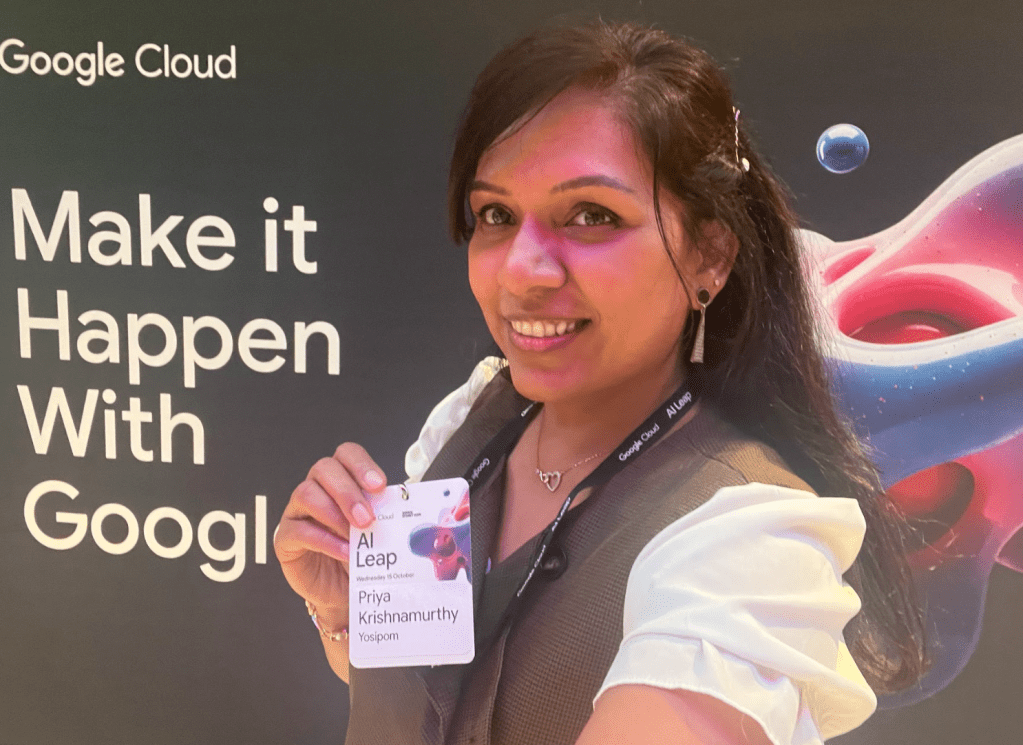
As co-founder of YosiFlow.ai, I came in eager to listen — and left energized, challenged, and inspired. Thank you to all the speakers, Googlers, founders, and investors who made this day one to remember.
💡This line hit different.
🗣️ “We’re moving from Generative AI to Action Intelligence.” — Natalie Piucco, Google Cloud APAC CTO, & the voice behind Google Assistant in Australia.
After her session, I had the chance to chat with Natalie — yes, the voice behind Google Assistant in Australia — and she genuinely leaned into what we’re building at YosiFlow.ai.
Turns out, solving “boring” business problems isn’t boring at all when it unlocks trustable AI automation for enterprise.
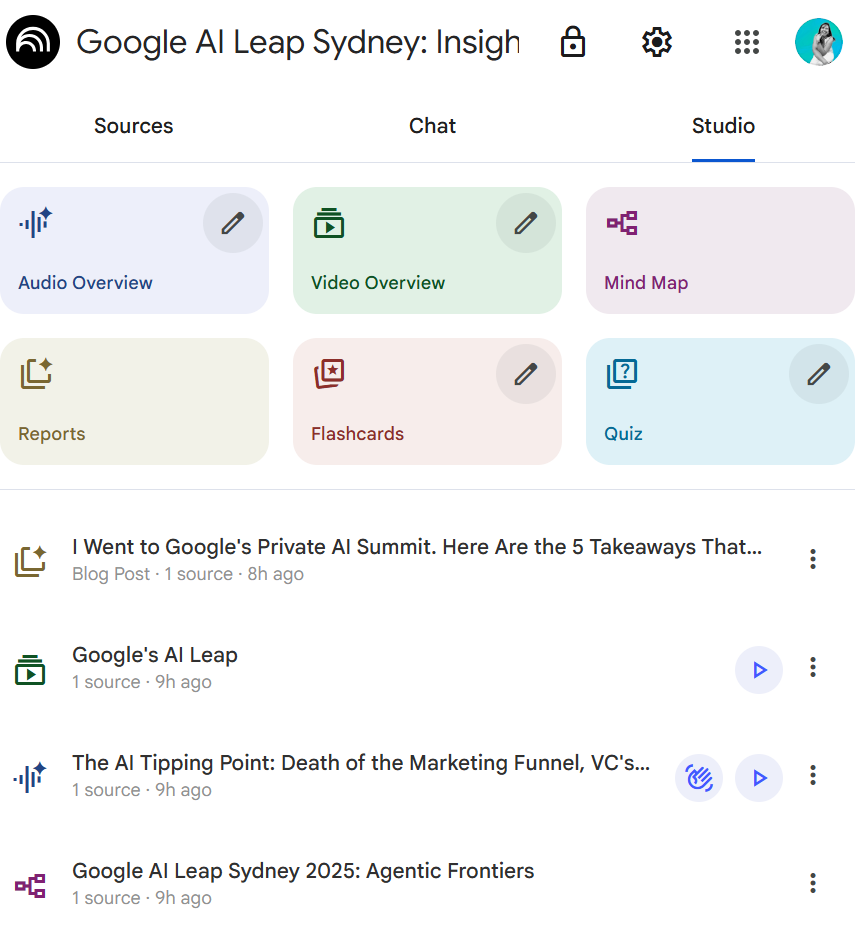
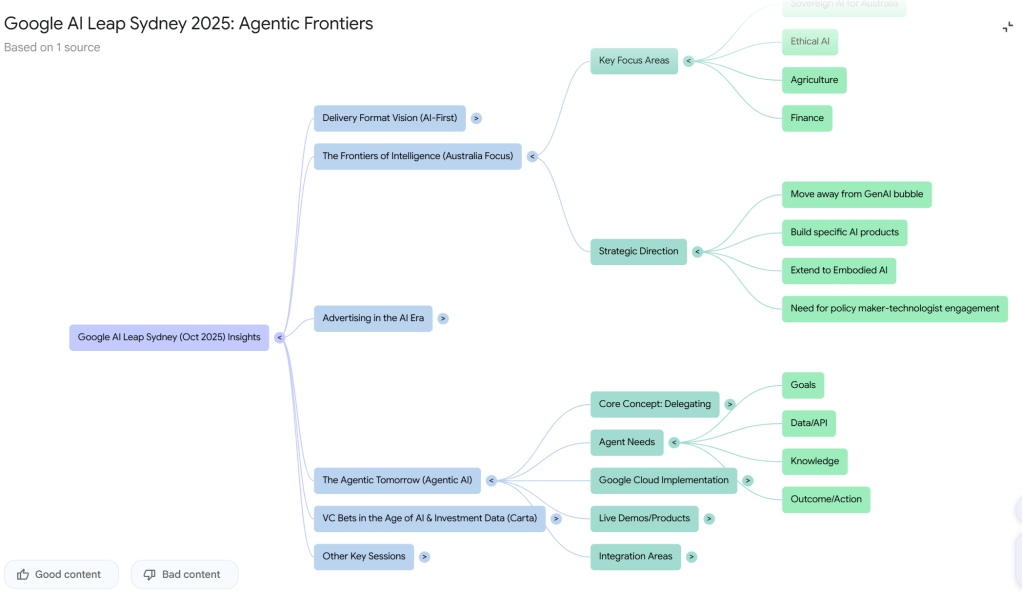
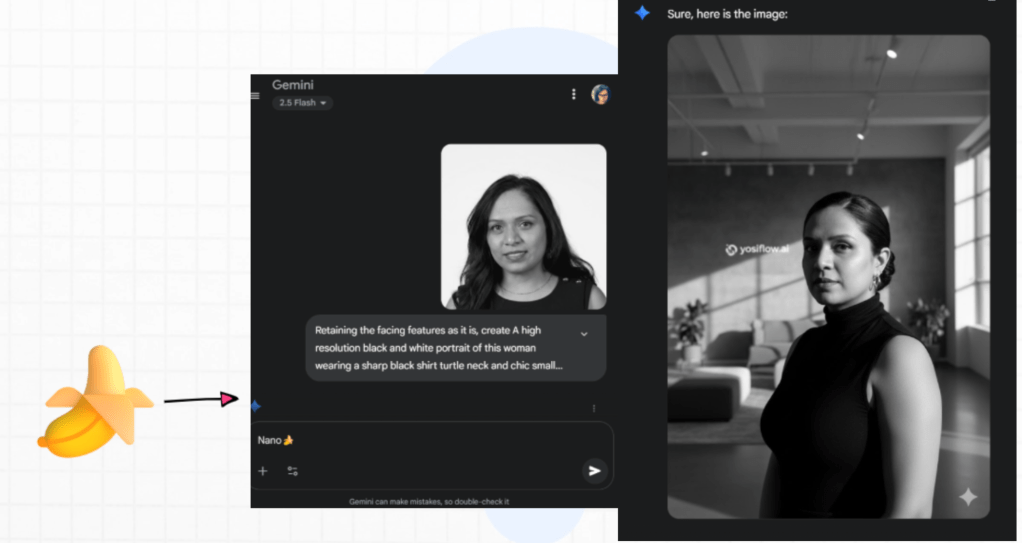
At Yosipom AI-first thinking shows up daily, We didn’t just attend #AILeap — we fed it into our own stack. NotebookLLM + Gemini Veo3 + Nano Banana for a futuristic vision, podcast, industry insights video, and a mindmap, all live before the event hangover fades! That’s AI-first in action.
1. From Searching to ‘Prompting’. The Next Big Shift is ‘Delegating’.
The way we interact with AI is undergoing a fundamental evolution, as outlined in “The Agentic Tomorrow” session. This progression can be understood in three distinct stages: we moved from ‘searching’ in the 1990s, to ‘prompting’ large language models in 2023, and are now on the cusp of ‘delegating’ complex tasks to autonomous AI agents.
This isn’t just a change in terminology; it’s a profound shift in our relationship with technology, moving from giving instructions to assigning outcomes. Google calls this pursuit “Action intelligence” and is studying the nuances of this new relationship in projects like “Project Mariner,” which researches how humans will interact with agents. The company is already building for this agentic future with tools like the Gemini Agent Builder, a low-code platform designed to let businesses create and deploy their own custom AI agents without requiring deep technical expertise.
2. The Marketing Funnel is Dead. Your Brand is More Important Than Ever.
In the “Advertising in the AI Era” session, a fascinating paradox emerged. While AI is rapidly commoditizing the technical aspects of running online ad campaigns, it is simultaneously making a unique brand identity and powerful creative messaging more critical for success than ever before. The current pitfall for most companies is misusing AI to simply generate more content, drowning in a sea of sameness, instead of using it to brainstorm genuinely better ideas.
This sentiment was perfectly captured by Mark Hermann, Founder & CEO of Everlab:
Having a brand and creative messaging is more important than it ever has been.
The clear takeaway is that the customer journey is now infinitely more complex and non-linear. The classic, predictable marketing funnel is officially dead, replaced by a dynamic ecosystem where a strong brand is the only reliable anchor. For marketers, this means budgets must shift from optimizing linear conversion paths to investing in high-quality creative that builds brand equity across a chaotic customer journey.
3. The AI Gold Rush is Over. Investors Now Demand ROI.
The consensus from the venture capital panels was unmistakable: the era of funding AI hype is tapering off. Investors are no longer dazzled by slick demos; they are demanding proof of a viable business model and a clear return on investment. As Matt Pearson, Co-founder of Fleet Space Technologies, bluntly put it:
Every funding round is a new story — and the market’s excitement is no longer about hype, it’s about ROI.
So, what are investors looking for now? VCs are focusing on startups with deep domain expertise solving problems in specific verticals—from AI that reviews legal contracts to AI-powered collars that monitor the health of cattle. They are rigorously scrutinizing metrics like “AI defensibility,” gross margins, and evidence of real enterprise adoption. Underscoring this market maturation, data from Carta showed that hiring figures in early 2025 were the lowest for a January in the last seven years, signaling a new phase of disciplined, sustainable growth. For founders, the message is clear: the pitch must now lead with a bulletproof business case and proven customer adoption, not just technological potential.
4. Social Media Discovers, But Google Still Closes.
One of the most surprising statistics of the day came from the advertising session. In an era dominated by social media feeds, the final point of conviction for consumers remains remarkably traditional. Even when a product is initially discovered on other platforms, 65% of purchase decisions in Australia still end with a search on Google or YouTube.
This highlights the four key user behaviors that define the modern consumer journey: streaming, scrolling, searching, and shopping. While discovery may be fragmented, the data confirms that search maintains its critical role as the final, decisive action before a purchase is made, solidifying its importance at the bottom of the (now shattered) funnel.
5. Australia is an AI Powerhouse—With a Paradoxical Flaw.
The “VC Bets in the Age of AI” panel shed light on Australia’s unexpectedly formidable position in the global AI landscape. According to investors, Australia ranks #2 in the APAC region for both AI startup growth and investment, pulling ahead of both India and Singapore. Furthermore, the country boasts a high concentration of AI PhDs—second only to the United States—who are at the forefront of fine-tuning foundational models.
However, this strength is offset by a critical paradox. Despite its deep talent pool and thriving startup ecosystem, Australia is one of the few developed nations that still doesn’t have a national AI strategy. This significant gap, which 104 other countries have already addressed, could hinder its ability to fully capitalize on its potential and compete on the global stage. This policy vacuum represents the single greatest risk to Australia’s burgeoning AI leadership, potentially ceding its current advantage to more strategically aligned nations.
——————————————————————————–
Conclusion: A Final Thought for the Agentic Future
The throughline of the day was a shift from scale to specificity, from hype to utility. The next winners in AI won’t be those with the biggest models, but those who build the most trusted and specialized agents. This is a future defined by context, trust, and deep, real-world integration.
This leaves us with a practical question to ponder: As we move from prompting tools to delegating tasks, what is the one repetitive decision in your life or business you would hand over to an AI agent first?
📌 Event Highlights & Speakers
Mike Langford (Google Cloud JAPAC) set the tone — leap ahead, but responsibly. AI isn’t just a technology race; it’s an ecosystem play. Startups, regulators, infrastructure, and users all need to move in concert.
Owning the Audience: The Founder’s Journey
With Cassandra McGill and Alex Zaccaria (Linktree), the fireside reinforced a timeless truth: scaling globally is rarely linear. The grind is real, but smart inflections matter. Aligning product, audience, and global expansion early is non-negotiable.
The Frontiers of Intelligence
Panelists Dr. Stefan Harrer (Sciansa), Suneeta Mall (Harrison.ai), Danielle Haj-Moussa (Main Sequence), and Dr. Sue Keay (UNSW AI) offered both challenge and direction:
- Australia needs sovereign AI solutions, not just rides on generic large models.
- Policy must evolve with tech; Suneeta emphasized that technologists and policymakers must co-design AI strategy, especially in domains like agriculture, ethical AI, and finance.
- Stefan urged building AI that discovers new research gaps — a deeper feedback loop between application and theory.
For YosiFlow founding team, this underscores the mandate: build auditable, trustworthy agents that enterprises can adopt with confidence (not just hype).
Advertising in the AI Era
With Marc Hermann (EverLab) and Google leadership, this session illuminated how AI is already bending the discovery → decision funnel:
- 65% of purchase moments in Australia still end via Google or YouTube — even when discovery began elsewhere.
- The future is a “planning + action” mode in search — conversational, contextual, eventually agentic.
- For early-stage startups, big bets (search / AI creative) replace micro A/B routines. Predictive attribution tools + prompt templates are early levers.
From EverLab’s journey, I heard: deploy AI in every inner loop before scaling headcount.
AI Leap: From Earth to Orbit (Fleet Space)
Matt Pearson gave us storytelling gold — and reminded us founders: hype fades, ROI matters.
The advice was clear — stage your narrative with realism, market timing, and relentless validation.
From “flying cars” to satellites, the shift is: when the world expects AI as baseline, can your product still surprise?
The Agentic Tomorrow & Live Demos
Natalie Piucco & Nilram Azadpeyma brought the future into focus.
- Google’s agentic paradigm: goals, data/APIs, knowledge, outcomes.
- Agentic loops are now real building blocks.
- Gemini for Business is pushing action intelligence with low-code agent builders — even non-technical teams will be able to design goal-driven agents.
- Demo highlights: multi-agent orchestration, decision chaining, and integrating cross-domain APIs.
For YosiFlow, this is directly adjacent to what we envision — enterprise agents that bring logic to ERP workflows, dynamically optimize, and act autonomously (with audit trails).
Venture Bets & AI Investment Trends
A powerhouse panel with Ian Gardiner, Tom Humphrey (Blackbird), Jackie Vullinghs (Airtree), Dan Krasnostein (Square Peg), and Peter Walker (Carta) shared hard truths and future bets:
- Australia is standing tall — #2 in APAC for AI startup momentum, behind only the US in some measures.
- VCs are backing domain, not generic AI. The pattern: vertical SaaS with deep domain insight + defensible AI.
- Growth is expected through rapid adoption, high gross margins, and clear value capture.
- One VC insight still flicks in my brain: “If you fund a startup, each round should last ~1,000 days.”
AI Community Showcases
Hearing from MLAI community, Trainset.ai, Velro.ai, Userdoc, and Build Club gave color to Australia’s AI startup tapestry. These are your peers, collaborators, or even “adjacent rivals” — and every one is building something foundational.

 Yosipom